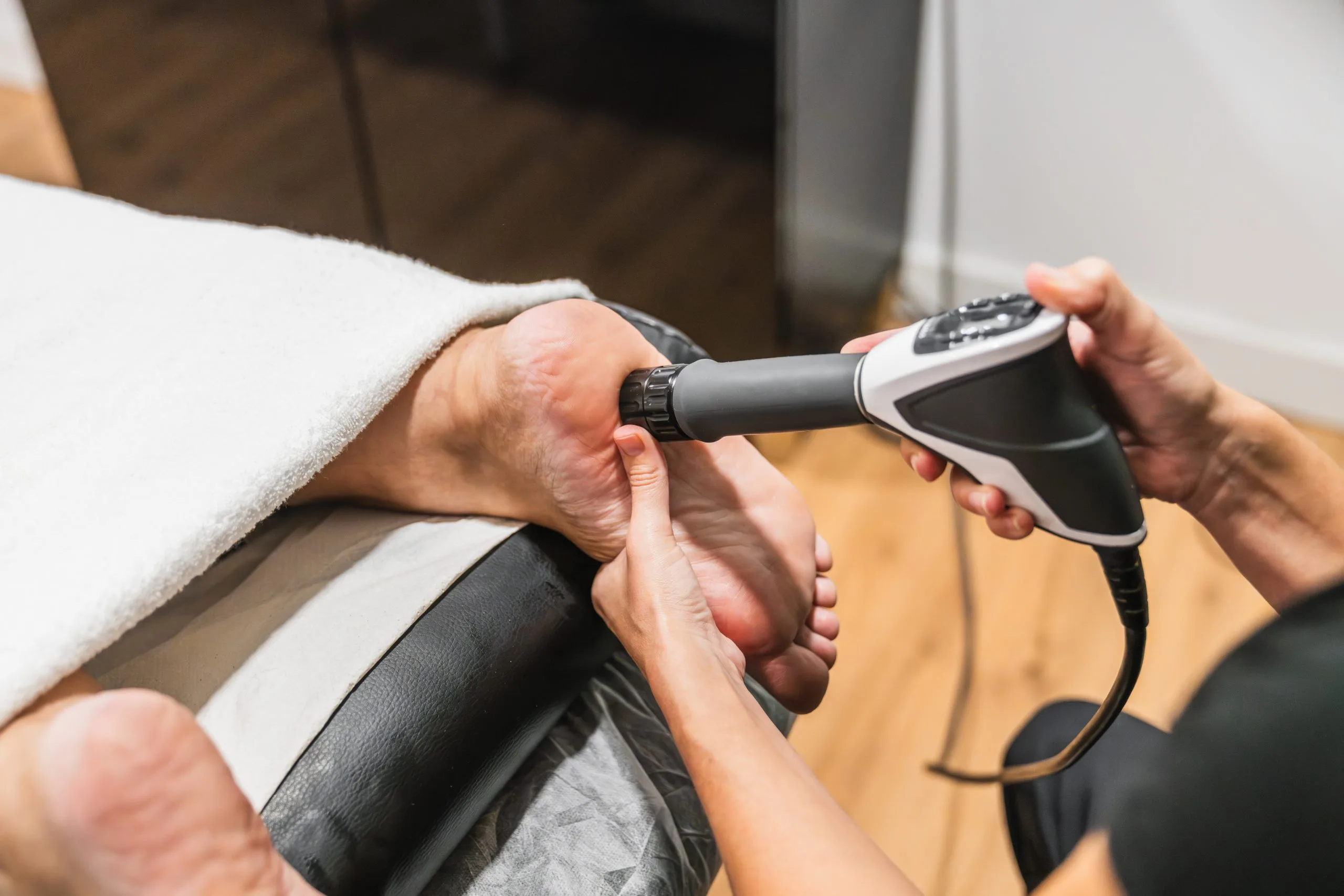
Yes – shockwave therapy works for plantar fasciitis, especially for heel pain that has lasted more than a few months and hasn’t improved with stretching, orthotics, or injections. It’s a non-surgical, no-downtime treatment that uses acoustic energy to restart healing in damaged tissue.
Below, we break down how it works, who it helps, and what the research shows.
The plantar fascia is a thick band of connective tissue that runs from your heel bone to the base of your toes. It supports your arch and absorbs shock with every step. When that band gets overloaded, tiny tears and irritation develop where it attaches to the heel – producing heel pain, the most common reason patients walk into our clinics.
The classic sign is sharp, stabbing pain with your first steps out of bed in the morning. Pain often eases after a few minutes of walking, then returns after long periods of sitting or at the end of a long day on your feet.
Most people start with the basics:
Calf and plantar fascia stretching exercises
Icing the heel to calm inflammation
Rest and activity modification
Supportive shoes, night splints, and custom or over-the-counter orthotics
Anti-inflammatory medications
Plantar fascial injections
The plantar fascia has limited blood supply. When irritation drags on past three to six months, the tissue stops behaving like a fresh injury and starts behaving like a degenerated one – thickened, disorganized, and full of scar tissue. Stretching alone doesn’t fix degenerated tissue, and that’s the gap shockwave therapy is designed to fill.
Shockwave therapy – also called extracorporeal shockwave therapy (ESWT) or extracorporeal pulse activation technology (EPAT) – delivers high-energy acoustic pressure waves through the skin into injured tissue. Nothing is cut, and nothing is implanted; it’s applied from outside the foot with a handpiece and conductive gel.
The pressure waves create a controlled mechanical stress in the fascia. That stress triggers the body’s repair response: new blood vessel formation, increased growth factor activity, and remodeling of scar-like tissue. In short, it converts a stalled chronic injury back into an actively healing one.
Focused shockwave concentrates energy at a specific depth, useful for deeper, more precise targets.
Radial shockwave spreads energy outward from the skin surface, covering a broader area of superficial muscle and connective tissue.
Both have been studied for plantar fasciitis. The right choice depends on where your pain lives and how deep the affected tissue sits.
You may be a good candidate if:
Your heel pain has lasted longer than three months
Stretching, orthotics, and shoe changes haven’t resolved it
You’ve had an injection with only short-lived relief
You want to avoid or delay plantar fascial surgery
You’re an active adult who can’t afford weeks of downtime
Sessions at our Beaverton, Lake Oswego, and other offices are done in-office and typically run about 10–15 minutes. Gel is applied to the heel, the applicator is moved over the painful area, and you’ll feel a rapid tapping or thumping sensation with intensity adjusted to your comfort.
No anesthesia, no cast, no crutches, no recovery period – you walk out and go about your day. Most patients complete a series of six sessions spaced over several weeks, often as part of comprehensive packages.
We also pair shockwave with laser at the same visit for soft tissue and tendonitis issues. Our laser therapy works on inflammation and pain signaling while shockwave drives tissue remodeling – two mechanisms working together.
Relief happens on two tracks. Acoustic waves temporarily reduce the sensitivity of local pain nerve endings, which is why some patients feel better within days. Then the deeper repair work builds over the following weeks:
Increases blood flow: Promotes neovascularization, bringing oxygen and nutrients to the injured area
Stimulates collagen production: Builds new fibers essential for repairing ligaments and tendons
Breaks down scar tissue: Helps dissolve calcifications and fibrotic tissue that block healing
Reduces pain signals: Provides an analgesic effect at the treatment site
Shockwave therapy for chronic plantar fasciitis has been studied for well over two decades and is FDA-cleared for this use. Published trials and pooled reviews consistently report meaningful pain reduction and functional improvement compared with placebo in patients whose symptoms persisted despite conservative care. Results build gradually over about 12 weeks rather than appearing overnight.
Non-invasive: No needles, no incisions, no anesthesia
Zero downtime: Walk in, walk out, keep working
High success rate: Proven effective for chronic cases that failed other treatments
Fast sessions: Each treatment is completed in minutes
Addresses the cause: Promotes actual tissue healing instead of masking symptoms
Combines well: Can be paired with regenerative medicine, such as PRP or DPMx injections
Shockwave therapy is very safe, but relief isn’t instant – patience through the treatment series matters. Some patients notice temporary soreness, mild redness, swelling, or a dull ache in the treated heel for a day or two. A small percentage of people don’t respond adequately and need a different plan.
So, does shockwave therapy work for plantar fasciitis? For chronic heel pain that hasn’t responded to conservative care, the evidence says yes – with the caveat that it works as part of a full plan, not as a standalone fix.
With six convenient locations across the Portland metropolitan area, relief is closer than you think.

About the Author
Daniel McManus, DPM
Check Your Insurance Coverage
Testimonials
I can't recommend them enough!

August 8, 2026